ARTICLE
Auteur(s) : Eduardo
López-Laso1, M Elena Mateos González1,
Rafael Camino León1, M Dolores Jiménez
González2, Javier Esparza Rodríguez3
1Pediatric Neurology Unit, Department of
Pediatrics
2Department of Neurophysiology. University Hospital
Reina Sofia, Córdoba
3Department of Pediatric Neurosurgery, University
Hospital Doce de Octubre, Madrid, Spain
Ictal crying (dacrystic seizures) is a rare, paroxysmal phenomenon
usually reported in association with hypothalamic hamartoma (HH) as
well as other lesions such as tumours, vascular malformations,
hippocampal sclerosis, or cerebral infarction (Wang et al. 1995).
Crying can occur as an unconscious ictal or postictal phenomenon.
Ictal crying can also occur with preserved consciousness, either as
an automatic behaviour without associated affect or as part of a
depressive reaction (Luciano et al. 1993). In the majority of
previously reported cases of crying seizures, ictal activity was
most prominent in the temporal lobe of the non-dominant hemisphere
(Luciano et al. 1993). Although dacrystic seizures have long been
related to HH and gelastic epilepsy, there are few reports
regarding this association (Williams et al. 1978, Kahane et al.
1994). We report the case of an infant suffering from dacrystic
seizures associated with a giant HH.
Case report
A newborn female presented, on her second day of life with a clonic
seizure of the upper limbs and oro-alimentary automatisms lasting
approximately one minute. She was born at term after a normal
pregnancy with delivery by Cesarean section because of
cranio-pelvic disproportion. Family history was unremarkable for
epilepsy or neurological disease. A cranial ultrasound revealed a
lesion on the diencephalon. Brain MRI showed a giant, diencephalic
lesion which was isointense to mildly hyperintense to grey matter,
measuring four centimetres of diameter, with posterior displacement
of the brainstem ( (figure 1) ). No
gadolinium enhancement was observed. No other malformations were
present. Her EEG was normal. She received treatment with
phenobarbitone.
Four weeks later she presented with a history of recurrent
episodes of prolonged irritability, agitation, crying, and
polypnea. She also experienced episodes described as an arrest of
activity, upper or lateral deviation of the eyes and generalized
tonic contraction. Ictal scalp-EEG was normal except for one
occasion following one of the seizures, when it showed mild
slowness of the background activity due to excess of diffuse high
amplitude slow waves. Sodium valproate was added to her
treatment.
During the next few months she continued to suffer five to more
than 30 daily seizures, with periods when seizures occurred as
frequently as every ten minutes. Many of the seizures she presented
were gelastic, with an occasional smile or mirthless laughter mixed
with crying. During some of the episodes she also presented upper
or lateral deviation of the eyes, unresponsiveness, staring and
mild myoclonic elements of both eyelids suggesting complex partial
seizures. She received treatment with topiramate, and
phenobarbitone was discontinued.
From the age of five months, some degree of mental impairment
became evident, she was unable to follow objects properly and she
had poor interaction with her surroundings. Failure to thrive was
noted and a hormone profile showed a mild elevation of LH and
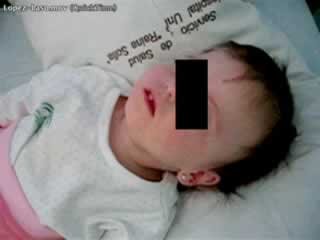
prolactin. She also presented several dacrystic seizures daily, all
of them stereotyped with crying as the most noticeable element of
the episode (see video sequence). These episodes presented as
clusters at sleep onset. A typical episode while falling asleep
would start with moaning followed by face-flushing. The moaning
then evolved to crying with lateral and upper deviation of both
eyeballs, along with clonic elements of the eyelids, which were
more evident on the left side. After a few seconds the crying
became less intense, she stared and oroalimentary automatisms
became prominent along with some slow horizontal movements of the
eyes and the head. At the end of an episode she went back to sleep.
Administration of rectal diazepam did not modify the clinical
presentation or the duration of the paroxysmal attack.
At the age of nine months she underwent mass resection through a
subfrontal route. Surgical intervention was complicated by a
subarachnoid hemorrhage secondary to the accidental section of a
branch of the internal carotid artery. She developed acute left
hemiparesis and a transient paresis of the third cranial nerve. A
post-operative MRI scan ( (figure 2) ) revealed
an ischemic stroke in the territory of the right middle cerebral
artery. Partial resection of the tumor was achieved.
Histopathological analysis of the resected tissue showed features
typical of hypothalamic hamartoma.
Following surgery, the seizure frequency ranged from six
episodes per hour to five seizures in 24 hours, most of them
dacrystic in type. These crying seizures remained relatively
stereotyped. Notwithstanding, the gelastic seizures stopped. She
also developed hydrocephalus, probably as a consequence of the
subarachnoid hemorrhage, that necessitated a ventriculo-peritoneal
shunt. At the age of 11 months, an EEG showed asymmetrical
hypsarrhythmia.
She is now two years and nine months old, and experiences seven
to eight dacrystic seizures a day. Some of these seizures are
followed by a brief series of extension and abduction of both arms
resembling extensor epileptic spasms. Her neurological development
is poor, she is hypotonic and language has not developed.
Interictal EEG ( (figure 3) ) shows an
epileptic encephalopathy pattern, with high amplitude slow
background activity and multifocal epileptic abnormalities,
predominantly in the left hemisphere, consisting of sharp waves,
spikes and slow waves, all of which suggest the presence of a
secondary, generalized epileptic process. She is being treated with
topiramate, lamotrigine and clobazam. She also needs thyroxine
supplementation. LH and prolactin serum levels normalized
postoperatively.
Discussion
Dacrystic seizures are rare, particularly in young children. Offen
and coworkers (1976) described a 69-year-old patient who had
paroxysmal episodes of crying which they presumed to be epileptic
in origin and proposed the term “dacrystic epilepsy”. Many of the
previous reports of crying seizures were of adult patients with
frontal or temporal focal epilepsy of lesional origin. The known
causes of these lesional seizures were tumors, vascular
malformations, hippocampal sclerosis and cerebral infarction
(Luciano et al. 1993, Wang et al. 1995). Luciano et al. (1993)
identified 11 published cases with dacrystic seizures and reported
on seven adult patients with crying during video-EEG-documented,
simple or complex partial seizures. Six of their seven patients had
EEG evidence of a right fronto-temporal seizure focus.
Our patient was an infant with a giant hypothalamic hamartoma
who presented with dacrystic and other types of seizures. HH
present most often with epilepsy. In the majority of cases,
epilepsy begins during the neonatal or early childhood period,
usually in the form of laughter seizures for which the term
“gelastic” seizures (Daily and Mulder 1957) is commonly used. Some
of the patients with HH and gelastic seizures can also present rare
ictal episodes of crying alone or together with laughter (Kahane et
al. 1994, Munari et al. 2000). From the age of two months, he
presented recurrent episodes of prolonged irritability, agitation,
crying, and polypnea, initially not diagnosed as epileptic. Some
months later, we identified the epileptic origin of the recurrent
episodes of prolonged irritability because of their paroxysmal
nature, in the absence of any precipitants and being relatively
stereotyped. Arzimanoglou et al. (2004), described two personal
cases of neonates who presented “bizarre frantic agitation, with
crying and grimaces that could last for hours, later followed by
more typical gelastic attacks” and related to HH. Our case
illustrates the difficulty of recognizing these subtle ictal
manifestations during infancy.
Ictal scalp-EEG recordings during gelastic and/or dacrystic
seizures are reported as rather inconclusive (Tassinari et al.
1997, Kahane et al. 2003). During the first months of life, the
several ictal and interictal scalp-EEG performed in our patient
were normal. After the surgical procedure, interictal EEG
consistently showed an epileptic encephalopathy pattern. We did not
obtain a post-surgery ictal EEG during the dacrystic attacks. The
stereotypes and recurrent nature of dacrystic, non-provoked
episodes in our patient strongly suggested an epileptic nature.
Data obtained from stereotactic intracerebral EEG recordings in
patients with HH have revealed that gelastic seizures (Munari et
al. 1995) as well as dacrystic attacks (Kahane et al. 1994) are
linked to the occurrence of an ictal discharge which remains
located within the hamartoma, sparing the other investigated
cerebral regions. Furthermore, the results of electrical
stimulation of the mass reproduce the gelastic or dacrystic
episodes (Kahane et al. 1997). Crying seizures in our patient
recurred postoperatively, suggesting that the ictal onset zone of
this type of seizures was not removed. Notwithstanding, the
gelastic seizures disappeared.
More than half of the patients reported with HH also suffer from
other types of seizures, mainly complex partial seizures,
tonic-clonic seizures, tonic seizures, falling seizures and
atypical absences, that may start at the same time as gelastic
and/or dacrystic seizures, although usually later (Tassinari et al.
1997, Arzimanoglou et al. 2003). These other seizure types are
sometimes immediately preceded by laughing or crying attacks, as we
observed in our patient, suggesting that ictal discharges within
the HH could trigger other seizures which seem to originate in the
cortex (Kahane et al. 2003).
References
Arzimanoglou et al. 2003 Arzimanoglou A, Hirsch E,
Aicardi J. Hypothalamic hamartoma and epilepsy in children:
illustrative cases of possible evolutions. Epileptic Disord 2003;
5: 187-99.
Arzimanoglou et al 2004 Arzimanoglou A, Guerrini R,
Aicardi J. Epilepsy in infants. In: Arzimanoglou A,
Guerrini R, Aicardi J, eds. Aicardi’s Epilepsy in
Children. Philadelphia: Lippincott Williams & Wilkins, 2004:
210-9.
Daily and Mulder, 1957 Daily DD, Mulder DW. Gelastic
epilepsy. Neurology 1957; 7: 189-92.
Kahane et al 1997 Kahane P, Munari C, Minotti L,
et al. The role of hypothalamic hamartoma in the genesis of
gelastic and dacrystic seizures. In: Tuxhorn I,
Holthausen H, Boenigk H, eds. Paediatric epilepsy
syndromes and their surgical treatment. London: John Libbey, 1997:
447-61.
Kahane et al 2003 Kahane P, Ryvlin P, Hoffmann D,
et al. From hypothalamic hamartoma to cortex: what can be
learnt from depth recordings and stimulation? Epileptic Disord
2003; 5: 205-17.
Kahane et al 1994 Kahane P, Tassi L, Hoffmann D,
et al. Crises dacrystiques et hamartome hypothalamique: à
propos d’une observation vidéo-stéréo-EEG. Epilepsies 1994; 6:
259-79.
Luciano et al 1993 Luciano D, Devinsky O,
Perrine K. Crying seizures. Neurology 1993; 43: 2113-7.
Munari et al 1995 Munari C, Kahane P,
Francione S, et al. Role of the hypothalamic hamartoma in
the genesis of gelastic fits (a video-stereo-EEG study).
Electroencephalogr Clin Neurophysiol 1995; 95: 154-60.
Munari et al 2000 Munari C, Quarato P, Kahane P,
et al. Gelastic and dacrystic seizures. In: Lüders HO,
Noachtar S, eds. Epileptic seizures. Pathophysiology and
Clinical Semiology. Philadelphia: Churchill Livingstone, 2000:
458-71.
Offen et al 1976 Offen ML, Davidoff RA,
Troost BT, et al. Dacrystic epilepsy. J Neurol Neurosurg
Psychiatry 1976; 39: 829-34.
Tassinari et al 1997 Tassinari CA, Riguzzi P,
Rizzi R, et al. Gelastic seizures. In: Tuxhorn I,
Holthausen H, Boenigk, eds. Paediatric epilepsy syndromes and
their surgical treatment. London: John Libbey, 1997: 429-46.
Wang et al 1995 Wang DZ, Steg RE, Futrell N.
Crying seizures after cerebral infarction. J Neurol Neurosurg
Psychiatry 1995; 58: 380-1.
Williams et al 1978 Williams M, Schutt W,
Savage D. Epileptic laughter with precocious puberty. Arch Dis
Child 1978; 53: 965-6.
|